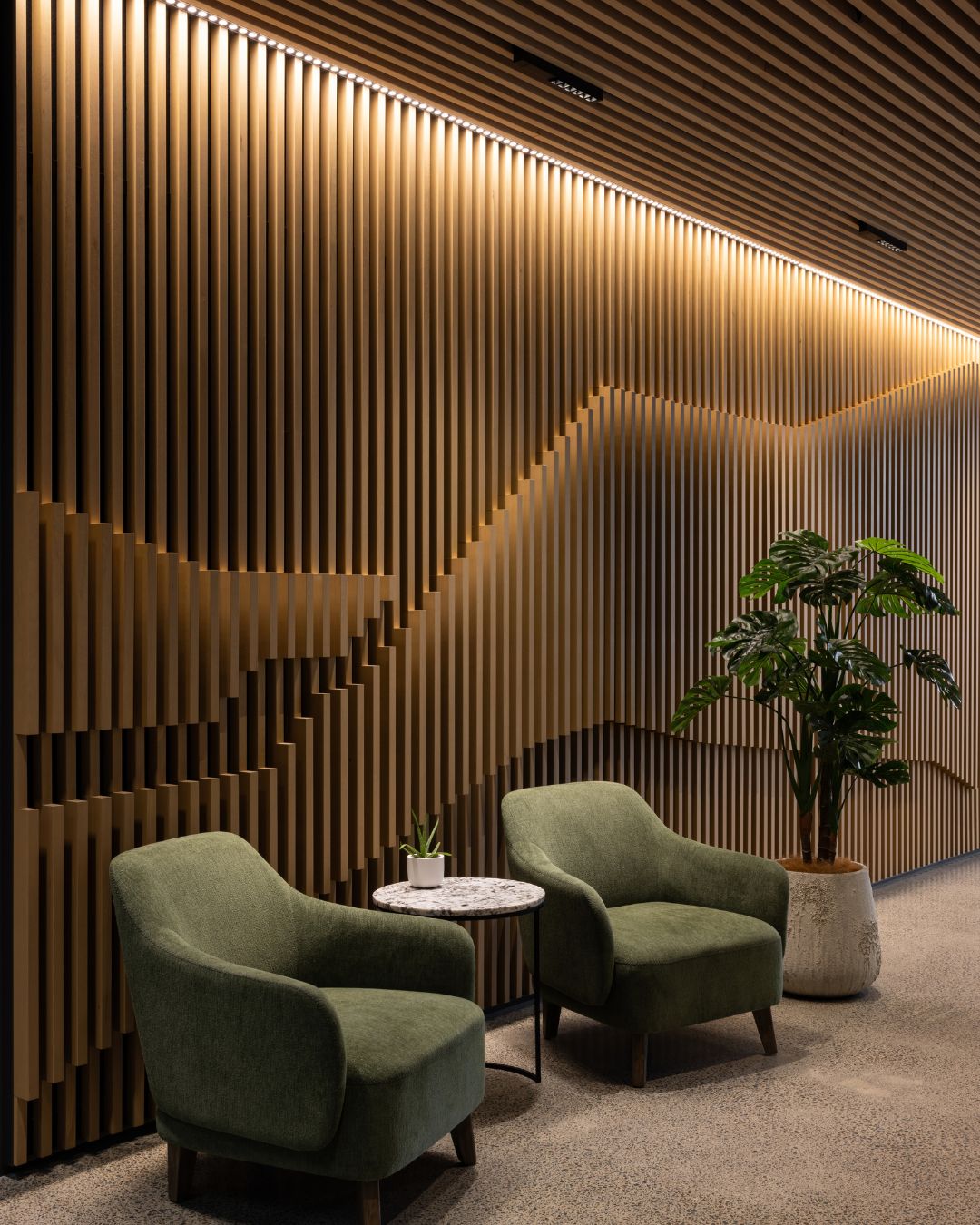
Atlas Concrete partnered with JWA Architects to transform its head office into a warm, sophisticated environment that reflects the company’s brand values. At the heart of the redesign is an extensive suite of timber ceilings, wall linings, and a striking curved feature wall, each crafted from finely detailed Hemlock timber battens. Potter Interiors was selected as the specialist supplier, chosen for its proven ability to deliver high quality timber solutions with precision and consistency.[/vc_column_text][/vc_column_inner][/vc_row_inner][/vc_column][/vc_row][vc_row gap="20"][vc_column el_class="bg-section-grey py-100 project-with-text"][vc_row_inner content_placement="middle" gap="20" el_class="py-100"][vc_column_inner el_class="col-content" width="1/2"][vc_column_text css=""]
Why Hemlock Was Chosen
Hemlock was specified for its clean, contemporary appearance, subtle grain, and warm tone. Its inherent stability made it ideal for the project’s most technically challenging element: a complex curved feature wall requiring each batten to follow the architectural form seamlessly. Potter Interiors and timber supplier NACCI worked closely with JWA Architects and installers EI Build to ensure every component met the project’s exacting standards. CMP Builders provided additional support throughout, helping ensure the design intent was fully realised.
Technical Precision Behind the Curved Feature Wall
Kiran, Technical Director at NACCI Architectural Systems, explained that the curved wall required particularly intricate detailing:
“The project required a striking curved feature wall (3m high, 7.5m long, with a radius of approximately 1700mm), demanding battens that could seamlessly follow the architectural form… Nacci’s intricate shop drawings provided the install team critical dimensions & cut lists keeping continuity between architectural plans and the final product.”
He also noted the importance of the system design, adding:
“Key components to solve the intricate detail was a solid aluminium batten joiner, curved TCR tracks & a strong clip to hold the battens in place.”
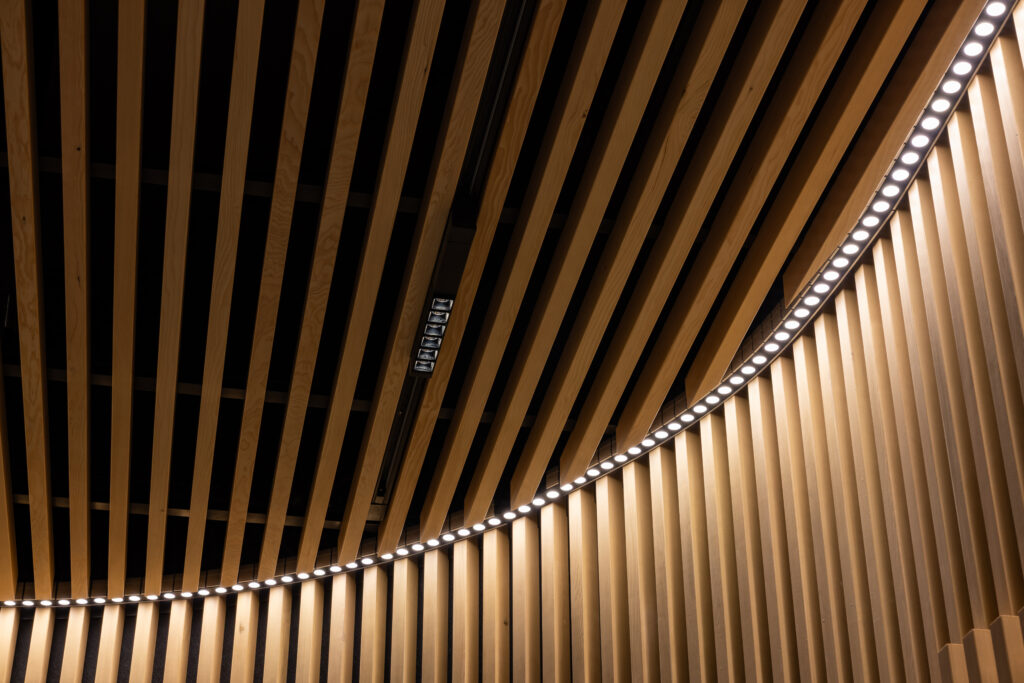
Beyond its visual impact, the batten system significantly improves the acoustics of the high traffic reception area. Concealed acoustic backing reduces reverberation and enhances noise control, while lighting and cabling are discreetly integrated behind the battens to maintain the purity of the curved form. As Kiran highlighted,
“Concealed acoustic backing integrated into the batten system significantly reduced reverberation and improved noise control… without visible disruptions.”
In total, the project utilised 3,280 metres of Hemlock battens—around 1,800 individual pieces—across a range of profiles including 30×90, 30×60, and 30×40. These appear throughout the ground floor, first floor, meeting rooms, and reception area, applied across both ceilings and walls. The stairwell features battens extending 12.5 metres high, incorporating stepped profiles and varying batten sizes.[/vc_column_text][/vc_column_inner][/vc_row_inner][/vc_column][/vc_row][vc_row gap="20" el_class="bg-section-grey article-content-section py-100"][vc_column el_class="bg-section-grey py-100 project-with-text"][vc_row_inner][vc_column_inner][vc_column_text css=""]
Installation Using NACCI’s Top Cross Rail System
Installation was completed using NACCI’s uniquely designed aluminium Top Cross Rails (TCR), compatible with timber or steel stud spacings of 400 mm, 600 mm, or 1200 mm centres. NACCI has completed a generic seismic design for non structural building elements and a PS1 for its wall and ceiling system. For this project, seismic requirements were integrated into the NACCI system and reviewed by structural engineers Inside Collab. Kiran noted:
“The system included generic seismic design for non-structural elements and PS1 certification, reviewed by Inside Collab engineers… with stringent load testing and independent engineering appraisal.”[/vc_column_text][/vc_column_inner][/vc_row_inner][vc_single_image image="9233" img_size="full" alignment="center" css=""][vc_column_text css=""]
Flexibility, Customisation, and Sustainability
The system’s flexibility—allowing installation via TCR or direct fixing—gives designers greater freedom to achieve their desired outcome. Local manufacturing also supports customisation beyond the standard range, including the integration of lighting within the profiles. As Kiran put it,
“The modular design supports easy maintenance with batten removal and resistance to wear in high-traffic zones,”
and the locally manufactured timber enables “sustainability, complemented by the system's efficiency in material use and potential for eco-friendly coatings.”
A Premium Entry Experience
The completed installation delivers a refined and memorable entry experience. The combination of Hemlock timber, Potter Interiors’ craftsmanship, and JWA Architects’ thoughtful design has resulted in a reception space that feels both inviting and distinctly premium.[/vc_column_text][/vc_column][/vc_row][vc_row gap="20"][vc_column][vc_row_inner gap="20" el_class="inspiration-gallery-section"][vc_column_inner][vc_column_text]
Atlas Concrete partnered with JWA Architects to transform its head office into a warm, sophisticated environment that reflects the company’s brand values. At the heart of the redesign is an extensive suite of timber ceilings, wall linings, and a striking curved feature wall, each crafted from finely detailed Hemlock timber battens. Potter Interiors was selected as the specialist supplier, chosen for its proven ability to deliver high quality timber solutions with precision and consistency.
Why Hemlock Was Chosen
Hemlock was specified for its clean, contemporary appearance, subtle grain, and warm tone. Its inherent stability made it ideal for the project’s most technically challenging element: a complex curved feature wall requiring each batten to follow the architectural form seamlessly. Potter Interiors and timber supplier NACCI worked closely with JWA Architects and installers EI Build to ensure every component met the project’s exacting standards. CMP Builders provided additional support throughout, helping ensure the design intent was fully realised.
Technical Precision Behind the Curved Feature Wall
Kiran, Technical Director at NACCI Architectural Systems, explained that the curved wall required particularly intricate detailing:
“The project required a striking curved feature wall (3m high, 7.5m long, with a radius of approximately 1700mm), demanding battens that could seamlessly follow the architectural form… Nacci’s intricate shop drawings provided the install team critical dimensions & cut lists keeping continuity between architectural plans and the final product.”
He also noted the importance of the system design, adding:
“Key components to solve the intricate detail was a solid aluminium batten joiner, curved TCR tracks & a strong clip to hold the battens in place.”
Enhanced Acoustics for High‑Traffic Spaces
Beyond its visual impact, the batten system significantly improves the acoustics of the high traffic reception area. Concealed acoustic backing reduces reverberation and enhances noise control, while lighting and cabling are discreetly integrated behind the battens to maintain the purity of the curved form. As Kiran highlighted,
“Concealed acoustic backing integrated into the batten system significantly reduced reverberation and improved noise control… without visible disruptions.”
In total, the project utilised 3,280 metres of Hemlock battens—around 1,800 individual pieces—across a range of profiles including 30×90, 30×60, and 30×40. These appear throughout the ground floor, first floor, meeting rooms, and reception area, applied across both ceilings and walls. The stairwell features battens extending 12.5 metres high, incorporating stepped profiles and varying batten sizes.
Installation Using NACCI’s Top Cross Rail System
Installation was completed using NACCI’s uniquely designed aluminium Top Cross Rails (TCR), compatible with timber or steel stud spacings of 400 mm, 600 mm, or 1200 mm centres. NACCI has completed a generic seismic design for non structural building elements and a PS1 for its wall and ceiling system. For this project, seismic requirements were integrated into the NACCI system and reviewed by structural engineers Inside Collab. Kiran noted:
“The system included generic seismic design for non-structural elements and PS1 certification, reviewed by Inside Collab engineers… with stringent load testing and independent engineering appraisal.”
Flexibility, Customisation, and Sustainability
The system’s flexibility—allowing installation via TCR or direct fixing—gives designers greater freedom to achieve their desired outcome. Local manufacturing also supports customisation beyond the standard range, including the integration of lighting within the profiles. As Kiran put it, “The modular design supports easy maintenance with batten removal and resistance to wear in high-traffic zones,”
and the locally manufactured timber enables “sustainability, complemented by the system’s efficiency in material use and potential for eco-friendly coatings.”
A Premium Entry Experience
The completed installation delivers a refined and memorable entry experience. The combination of Hemlock timber, Potter Interiors’ craftsmanship, and JWA Architects’ thoughtful design has resulted in a reception space that feels both inviting and distinctly premium.